Long Days, Fireworks, Saints, and the Spanish Gothic
 |
| Summer Solstice Sunrise at Stonehenge |
Holy Moly! We will be together in Barcelona in five days!
Most of us will arrive in Barcelona on Tuesday, June 23rd, the eve of one of the most important saint days for that city. That night we'll experience an evening celebration that's steeped in history, astronomy, spirituality, and community. The saint day on the 24th marks both the birthday of St. John the Baptist and the summer solstice- the longest day of the year and official arrival of summer. Humans have honored soltices and equinoxes at least since neolithic ties, relying on monuments like Stonehenge to calculate these annual langmarks in the earth's relationship to the sun. (In Spain, the Abrigo de Matacabras is a neolithic dolmen tomb oriented to align with the solstices like Stonehenge does.)

While 2026's actual longest day of the year falls on June 21, Catalunya celebrates the solstice on the eve of St. John's Day, an evening known as the Nit de Sant Joan/San Juan, or Nit del Foc (night of fire). For Catholics, St. John's earthly birthday is June 24, just as Jesus' is December 25th; the ancient Romans celebrated the summer solstice on June 24th and the winter solstice on December 25th. For Barcelona, the combination of history dating back to the Romans and two millennia of Catholic roots makes for a lot to rejoice for, and this festival is known for having a very significant local participation.
Why the eve of? Because St. John's birthday, June 24th is a government holiday, and much more of a quiet, religious or domestic day.
 |
| image source |
Catalonia adds another level of meaning to tie together all Catalan-speaking people. A special fire, the Flama del Canigo, is kept burning all year at a castle in the Pyranees. On the 22 of June, the flame is taken to the top of the Pic du Canigo in the Pyranees, where it provides the flame to start a bonfire. From there, teams take torches with the flame to light bonfires throughout Catalonia, which symbolically drive out demons, add strength to the sun for summer growing, and commemorate the Catalan bond. Throughout the city, people will drink the famous Catalan sparkling wine Cava, eat Coca de Sant Joan-- a sweet round flat bread meant to symbolize the sun, set off fireworks to drive away demons, and take a cleansing swim at midnight. Perhaps we can secure a couple of Cocas de San Joan before they all sell out.
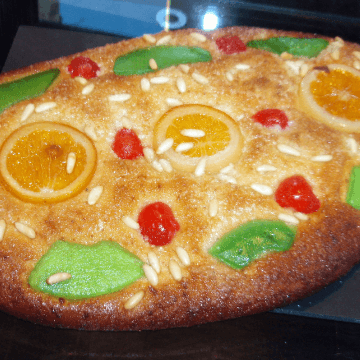 |
| I bet this won't be like my grandmother's fruitcake. |
! Expect a rowdy city! Fireworks, apparently, won't happen at midnight.... they'll happen all night. This could be a reminder to light sleepers to pack some method of sound dampening.
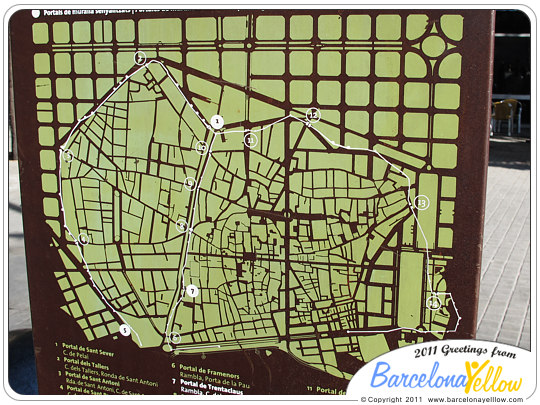 |
| The Gothic Quarter, you may remember, is built into and over the Roman city, Barcino. What does the map above tell you about Gothic town planning in relation to the modern city? |
Entering Barcelona's Gothic Quarter
(note-- I define a number of historical and architectural terms at the bottom of this post)
Assuming our flights go smoothly, we will arrive at the hostel in the early afternoon, gearing up to walk to the Gothic Quarter for a 4:00 pm (or 16:00, to use the European clock) visit to Barcelona Cathedral, that is, the Cathedral of the Holy Cross and Saint Eulalia. Don't forget to cover your shoulders or bring a scarf, and wear pants, shorts, or skirts that are reasonably modest-- which for Catalonia means close to the knees.
If all goes very smoothly indeed, we could have the opportunity to connect in the Gothic Quarter with both the Christian side of the Nit de Sant Joan holiday, learning a bit about Barcelona's Catholic architecture, and the pagan side, perhaps catching a sighting of the Flama del Canigo on its way to its first stop in Barcelona, a ceremonial bonfire at the Plaça da San Jaume right around the corner from the Barcelona Cathedral. The Plaça da San Jaume (Plaza of Saint James) is the political and historical center of the Gothic Quarter, and, by extension, Barcelona. It was a key crossroads in Roman Barcino and is where Barcelona City Hall faces the Palau de la Generalitat, from where 133 successive Presidents of Catalonia have governed, including Salvado Illa i Roca, president since 2024. As we take our first stroll around the parts of the Gothic Quarter near the cathedral, also keep your eyes peeled for Roman arches and fortification walls. We can touch some 2000-year old history.
 |
| Basilica de Santa Maria del Pi, Barcelona, a 15th century Gothic church in Barcelona. |
The Gothic is an architectural style of the High- and Late- Middle Ages in Europe. Gothic architecture was originally known for its lightness, soaring heights, brilliant colors, and ornate detail. Somewhat confusingly, only that last quality, the ornate aspect, connects the Gothic Period to many of our more recent uses of the word Gothic- like Gothic literature, Gothic rock music, or Goth culture, all of which we know for their darkness, subculture appeal, and dominance of black over jeweltones-- and yes, their love of ornate detail.


1831 illustration for Mary Shelly's Gothic Horror novel Frankenstein, and wikipedia's vision of Goth subculture, and Cathedral of St. Peter, Cologne, "the third tallest church in Europe after Sagrada Família and Ulm Minster, and the tallest cathedral in the world," constructed from 1248-1880.
There are a few reasons that we use Goth/Gothic differently today than the style of architecture looks. First, the word was first used pejoratively, like so many cultural terms, as a way for Renaissance thinkers to distinguish their enlightened ideals and qualities from the Dark Ages, as they saw them; and the Goths, whom they thought of as barbaric, which came before them. Another reason is the fact that Gothic architecture has lasted for centuries, and the soot and dirt of city life had transformed their original light facades to the dark edifices that dominate many town and cityscapes in Europe by the time of Gothic fiction in the 18th and 19th centuries. Lastly, the Middle Ages didn't flinch from sharing some pretty grisly aspects of life and of Christian theology-- crucifixions, fire and brimstone, the demos that inhabited hell.
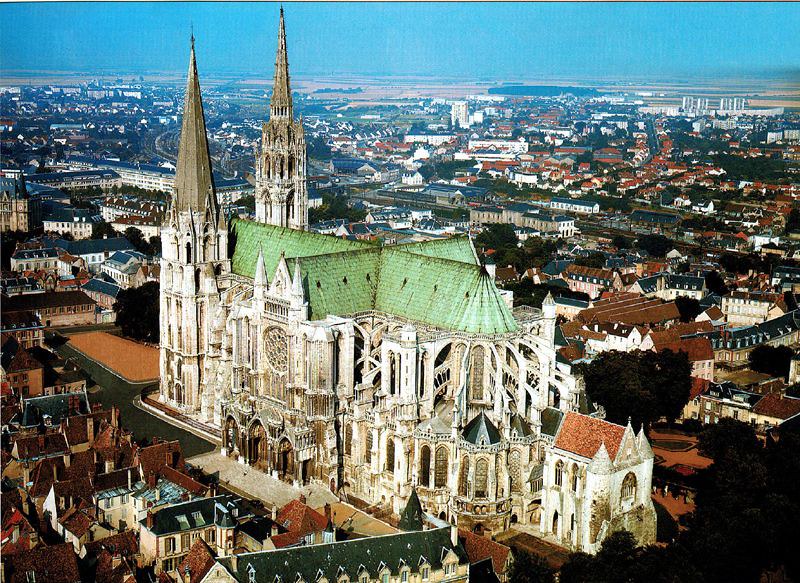 |
| Cathedral of Our Lady of Chartres, France. major construction, 1194-1220 ce, a high-Gothic Cathedral |
But first, the bright side: partly funded by the mania for pilgrimage, massive cathedral architecture projects took place throughout the Middle Ages all over Europe, particularly in France and Italy, so much so that Benedictine chronicler Rodulfus Glaber wrote: "...on the threshold of the aforesaid thousandth year, ... it befel almost throughout the world, but especially in Italy and Gaul, that the fabrics of churches were rebuilt... every nation of Christendom rivaled with the other, which should worship in the seemliest buildings. So it was as though the very world had shaken herself, and cast off her old age, and were clothing herself everywhere in a white garment of churches."
For architects of the Gothic Period, which lasted roughly from the 12th to 16th centuries, several momentous engineering innovations made it possible to achieve that sense of soaring lightness, the achievement of seemingly infinite height, and the admission of far more natural light possible. Two of the most critical and readily recognizable of those innovations are the pointed arch and the flying buttress.
 |
| Vaults formed by high-gothic ribbed, pointed arches at Saint-Denis in Paris |
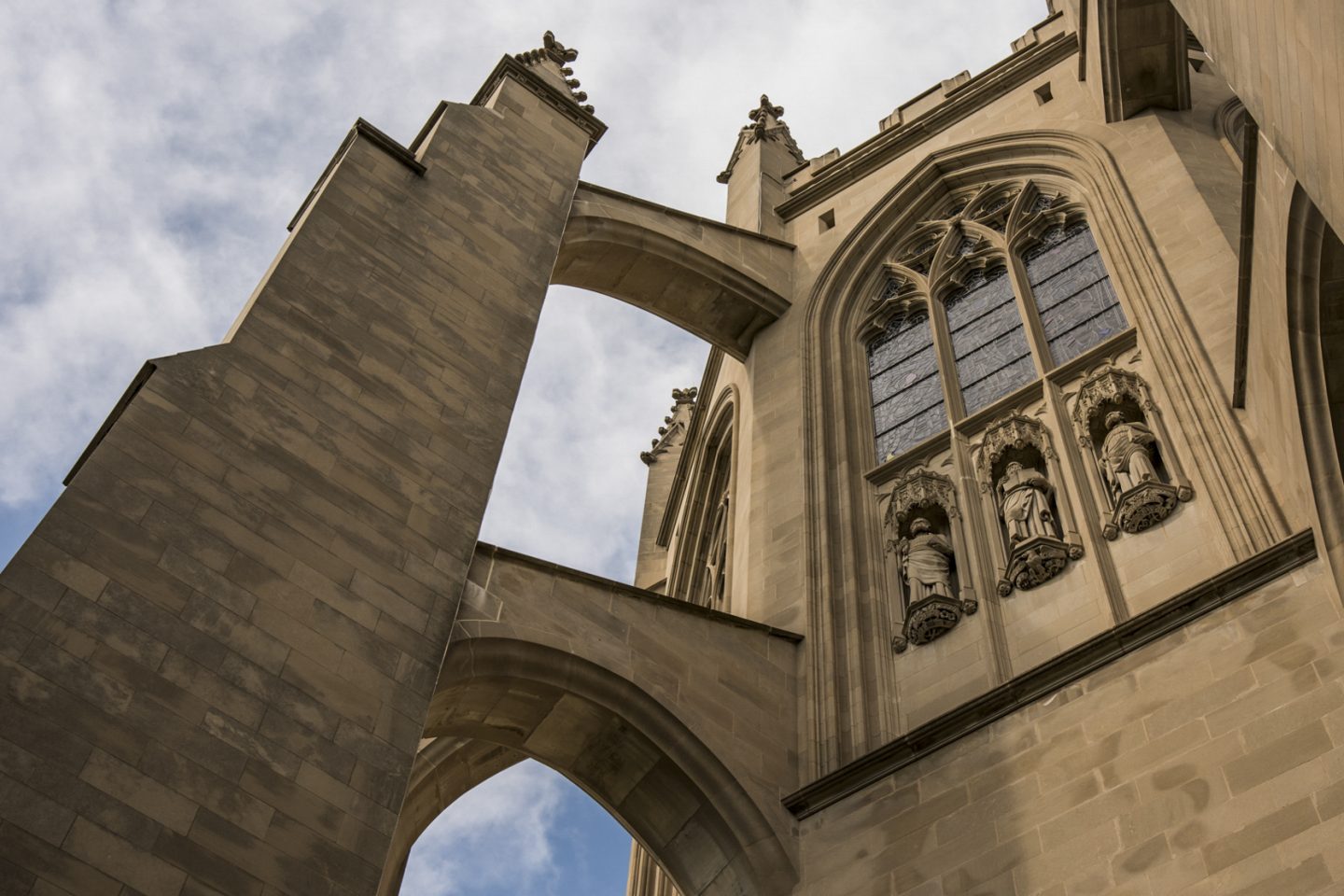 |
| Flying buttress on the National Cathedral in Washington, DC |
However, those innovations didn't reach Catalonia in time for the construction of the Barcelona Cathedral, which is officially the Cathedral of the Holy Cross and Saint Eulalia. For this reason, our first cathedral visit will serve as a super valuable way to see how architecture got from the rounded arches that the Romans spread across Europe's architectural landscape to the pointed arches that we will get to experience in one of their most profound applications just two days later, on Thursday when we visit the Basilica Sagrada Familia (which will come up two of three posts from now).
Our destination for Tuesday, Barcelona Cathedral/Cathedral of the Holy Cross and Saint Eulalia, did not stand out as a striking example of Gothic Architecture when it was built
 |
| Cathedral of the Holy Cross and St. Eulalia as it was in the 1880's. |
Again, the high Gothic style that was blanketing France and Italy reached Barcelona after this seat of Barcelona's Diocese was built. The Cathedral of the Holy Cross and St. E is a great example of the Catalan Gothic, which kept the awe on the inside, much in the way that earlier Romanesque churches had. One way I heard Romanesque architecture described is that it's like the soul of the Christian should be: plain on the outside and glitteringly beautiful on the inside. The Catalan Gothic sought to create large spanning naves (that's the part of the church where people sit). Catalan Gothic did not seek to build the tallest possible buildings, but to create balanced dimensions. I can't wait to get inside to see how that feels.
Barcelona Cathedral is dedicated to the Holy Cross and Saint Eulalia, one of Barcelona's Patron Saints. (I shared her story in the last post, and we will see and learn more in the church. Her relics are in the cathedral's crypt, and we'll learn a cool story about the geese in the cloisters (the covered walkway that surrounds the courtyard). I am not sure we will be able to go in the crypt and the cloisters-- but I hope so!
 |
| Saint Eulalie's Crypt |
 |
| Chapel of the Lady of the Rosebush. |
But the inside is not the end of the story.
Barcelona did eventually fall in love with the Gothic Style and became deeply invested, so much so a new façade or front face was added to the cathedral at the turn of the 19th to 20th century. Below, you see that the Cathedral now looks much more like the other cathedrals above, though of course it does not go nearly as high as the other examples I showed, or as the Basilica Sagrada Familia does further north in Barcelona. 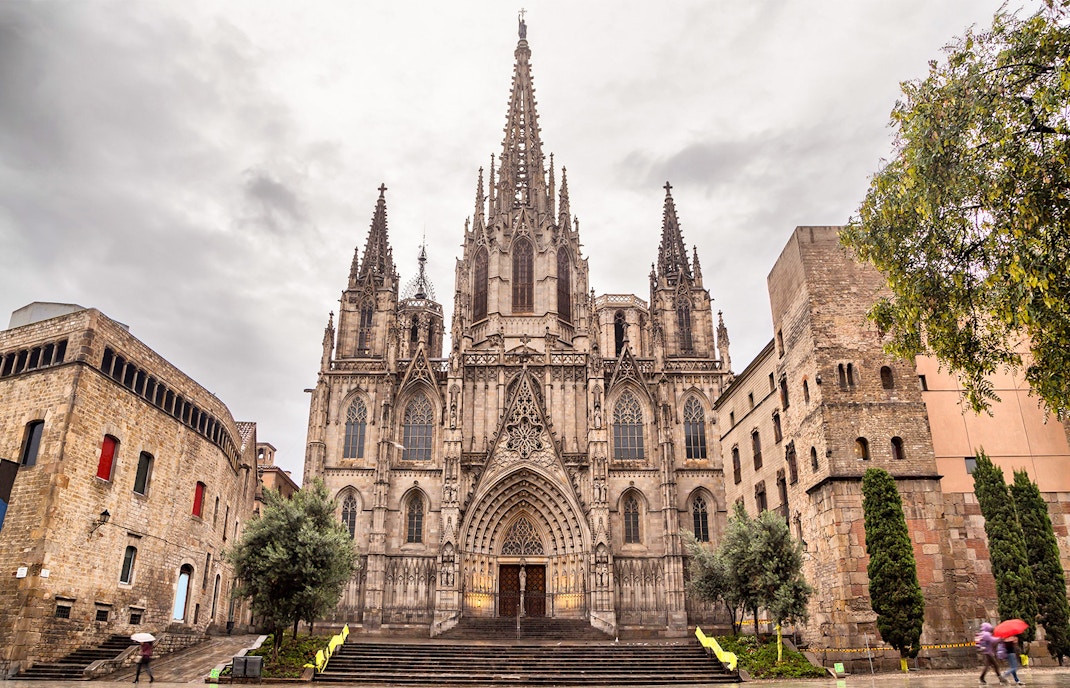
 |
| Oh no. I didn't mark the source of this image. It gives a legend to help 'read' the 20th century facade. |
Here's another important fact to keep in mind as we explore the Gothic Quarter/old city. When you see elements that look particularly gothic like the cathedral facade now does, you are most likely looking at relatively new elements. When Barcelona hosted the International Exposition in 1929, "it was as though the [old quarter] had shaken herself, and cast off her old age, and were clothing herself everywhere in a garment of gothic features."
We will only officially visit two churches all together-- but I recommend that you take advantage of the opportunity to experience the historic architecture that will be all around us-- you can step into almost any church in Europe unless service is taking place and just take a moment to connect with the architecture and the people who have experienced awe there before you.
If you'd like to know some of the guiding principles and terminology of Gothic Cathedral Architecture, Ben Loomis has a fantastic substack here. Here's an oldy but still a goody-- Andrea Kirby on how to read a Gothic Cathedral Facade.
Terms:
Basilica-- for the Romans, a basilica was a large, generally rectangular building that served a number of public functions such as court proceedings and places for oratory.
A Christian Basilica refers to a style of church architecture that is rectangular, has a long central nave (gathering place), and generally has a long aisle on either side of the nave.
A Catholic Basilica is a church that has received special priviledges, typically from the pope, and is in a large and notable building. Some catholic basilicas are basilica-style buildings; but they don't have to be.
A Cathedral has special functions in the Catholic Church as it is the central church of an area served by a bishop.
The Barcelona Cathedral (that is, the Cathedral of the Holy Cross and Saint Eulalia) is, very generally speaking, a basilica-style building, but it is the Cathedral of the Archbishop of the Diocese of Barcelona.
The Basilica Sagrada Familia is not a cathedral (though its is bigger, taller, and more widely known than the Barcelona cathedral. Pope Benedict XVI gave Sagrada Familia its definition as a Basilica church in 2010.
Like the Gothic, the Romanesque Period was named after-the-fact by people working to distinguish it from times before and after, and they chose the Roman Arch as the distinguishing feature to name it after. In its own time, the style would have just been called Modern. The Romanesque Period overlapped with the Gothic, with some areas adopting Gothic innovations earlier than others, and ran from about the 11th-12th centuries.
The Gothic Period is an era in art and architecture in the middle- and late- Middle Ages that evolved from Romanesque Architecture. The Gothic is known for tall pointed arches, flying buttresses, huge expanses of stained glass, and ornamental façades, especially the western façades.
In church architecture, Catalan Gothic does not strive for great heights, but tends to balance dimensions of width with height, so there are no long sloping roofs so characteristic of central and northern Europe, and its buttresses are as tall as the naves. The naves are quite wide, in the Girona cathedral, for instance, being the widest in gothic history, in contrast to English gothic, which has some of the longest naves. The buttresses penetrate into the building to form inner structural spaces as well (side chapels). Buildings also have fewer windows because the Mediterranean light is much stronger than the rest of Europe. Sparsely decorated, they have no figurative motifs on their pillars and no notable intricacy in their vaults. The vaults tend to have large, sculpted and painted keystones, however. (definition wikipedia)
Neo-Gothic/ Gothic Revival (also referred to as Victorian Gothic) is an architectural movement that after a gradual build-up beginning in the second half of the 17th century became a widespread movement in the first half of the 19th century, mostly in England. Increasingly serious and learned admirers sought to revive medieval Gothic architecture, intending to complement or even supersede the neoclassical styles prevalent at the time. Gothic Revival draws upon features of medieval examples, including decorative patterns, finials, lancet windows, and hood moulds. By the middle of the 19th century, Gothic Revival had become the pre-eminent architectural style in the Western world, only to begin to fall out of fashion in the 1880s and early 1890s. (definition wikipedia-- other definitions mine)
Both Romanesque and Neo-Gothic are periods innovated by using older architectural vocabulary in new ways


Comments
Post a Comment