As I wrote last time, the Romans began their invasion of the Iberian Penisula, which the Romans knew as Hispania, in 218 BCE* . The Iberian Peninsula served Spain as a training ground for their many imperial actions, including those against the Carthaginians, the Iberians, the Lusitanians, the Gallaecians, and other Celts. By 117ce , the Romans had conquered more and more of the areas of Europe, North Africa, and the Middle East until they essentially ruled huge territories all the way around the Mediterranean Sea.
*(BCE= before the common era; 218 bce equals 2044 years ago. In dates bce, smaller numbers = more recent. In Common Era dates, larger numbers are more recent. Some sources use AD rather than CE, to designate anno domini, because in the USA we use a Gregorian Calendar that resets at zero for the time of Jesus. If this leaves you confused this source might be helpful. )
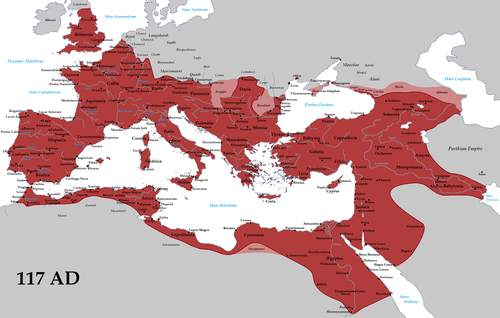 |
| Roman territory at it's greatest extent. |
Rome managed this influence on the ground by encouraging veterans from their wars to settle in the territories they wanted to influence. In 14 bce, for example, this guy...  |
| Augustus of Primaporta, marble, about 6'5", 1st c. ce, marble, Vatican Museums. |
...Emperor Augustus, settled about 100,000 veterans in Spanish and Gallic colonies in that year alone. Those settlers helped to begin the process of Romanization-- slowly aculturating a colony to new religious, economic, governmental, and cultural processes. 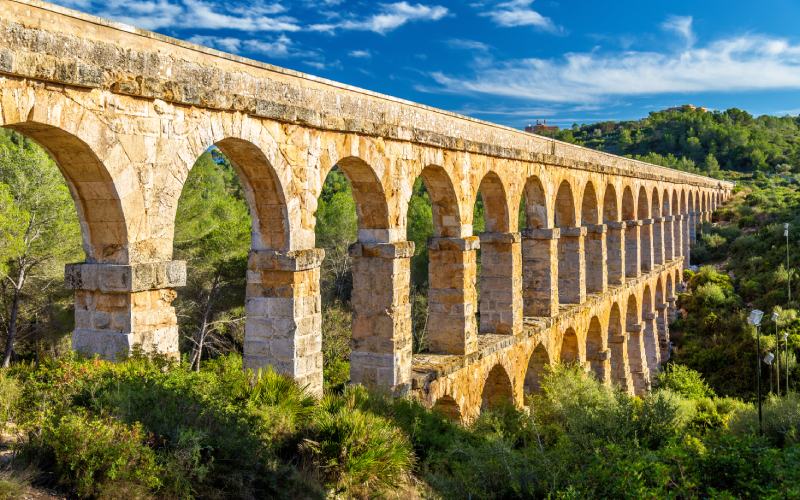 |
| Les Ferreres Aqueduct, Tarragona, Spain, 1st c bce-1st c ce |
Romans gave the Spanish a centrally organized government, economic growth, increased agricultural potential through irrigation, access to water, generally, by aqueducts, cultural experiences like public baths and gladiatorial competitions, a shared religion-- Roman mythology with a heavy overlay of the cult of the empire. Spain gave Rome metals such as gold, tin, silver, and lead, sheep for wool, crops such as wheat, grapes for wine, olives, a rich source of seafoods, and, eventually, a nation of people who furthered their imperial interests. This worked out a great deal better for the wealthy than regular folks.
Anyone who wanted to deal (through writing) with the bureaucracy and/or with the Roman market had to write in Latin. Until very recent archeological evidence, historians believed that the Romans brough the first writing to Spain. In the last ten years, a few hints have suggested that celtiberians (a cuture that merged celtic and indigenous iberian elements) may have had a written script- but it has not been translated. Regardless, after the Roman invasion and Romanization, writing became much more widespread and important, and Latin ruled the written world.
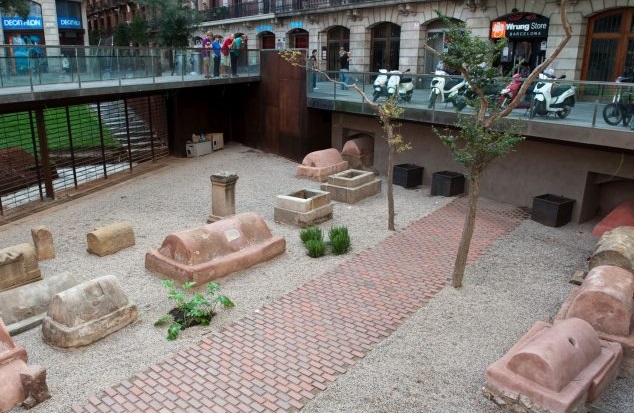 |
| he Via Sepulcral Romana is a Roman necropolis dating from the 1st to the 3rd century AD,[1] located in the Plaça de la Villa de Madrid |
Many other aspects of Roman life dominated the Iberian Peninsula beginning in the last years of the 1st century bce: Roman law supplanted local laws, Roman religion (flavored powerfully with the cult of impericism, and socio/cultural institutions like public baths and gladiator fights became part of the social fabric. Though in the countryside Roman traditions did not take over as fully as in the cities, the diverse peoples of the Iberian Peninsula gradually began to see themselves as Roman.
Speaking of cities, it was also Emperor Augustus who founded Barcelona. In about 15 bce, the Romans established the town of Barcino in what later became the medieval quarter of Barcelona, centered on what is today the Plaça de Sant Jaume (St. James's Square), about 20 minutes walk east from TOC hostel*.
*While in Barcelona, if you face the sea, you're facing roughly east. Tick a quarter circle to your right, you face roughly south, another quarter turn right and you face east, and another quarter, you face north. I'll likely use these ordinal directions to indicate where a given landmark is in relationship to TOC hostel.
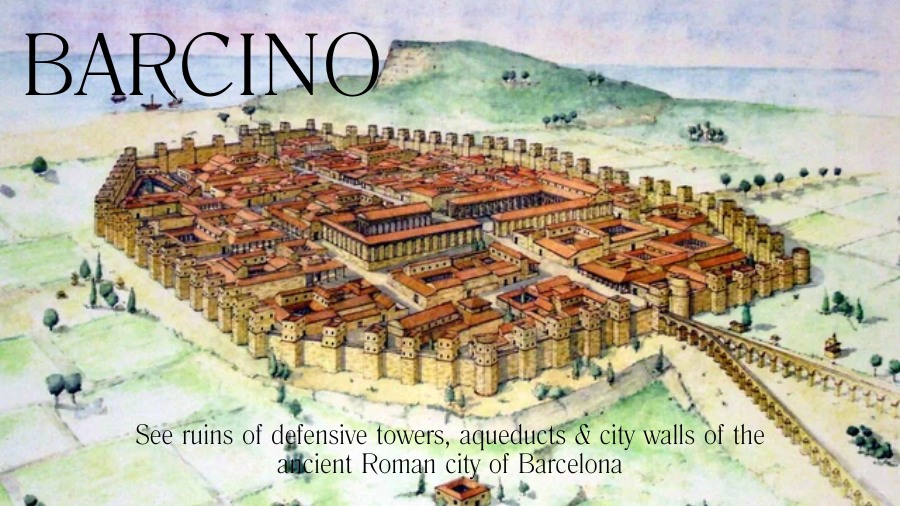
Rome dominated Spain for six centuries, from the first century bce- to the 5th century ce. By the second century ce, The oval-shaped town of Barcino had between 3500-5000 inhabitants. The wealth of the town aroused interest from the North. In the 3rd century ce, Germanic tribes made their first raids on the city, causing Barcino to increase fortifications in the city substancially, surrounding the city with a perimeter wall just under a mile long, between 6-36 feet high, and dotted with 78 towers, some 5 stories high. In the fourth century, the Roman Empire had lost stability.
Visitors today can still see evidence of the Romans in many parts of the city, including, the remainders of the walls and towers in many parts of the city, including...
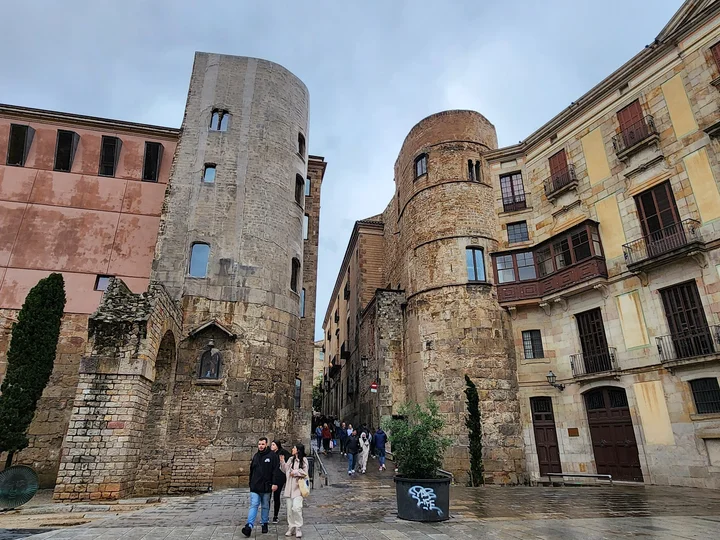 |
| ...remains of Roman walls in Plaça Nova, 17-minutes walk due east from TOC, and... |
 |
| ... in the Plaça dels Traginers... |
 |
| ... and, a Roman Temple, most likely dedicated to Augustus, Is now surrounded by medieval walls in a building that I think is now owned by the Barcelona Hiking Club (Centre Excursionista de Catalunya), but I haven't pinned that down yet. I'm hoping some of us find the little sign pointing it out and make our way in to see the 2000-year-old columns now preserved by the Museum of the History of Barcelona. |
 |
| Eyes peeled for the Temple Roma D'August..... |
 |
The temple would have been about 120 feet long. The sandstone came from Montjuïc Hill (near the institute, in other words)
|
The Museum of the History of Barcelona maintains extensive displays on the history of the Romans in Catalonia, and keeps a valuable online timeline of the history that I'm covering in prose here.
Just as I was finishing this post, I found a great website about Barcino that included this full city representation...



Comments
Post a Comment