Prehistory of Spain, Part II
Buenos Tardes (well, it was late afternoon when I wrote, but didn't proofread til this mornin'.)
Welcome to my second post about the history and culture of Spain. Today I'll finish out the long period of human prehistory, that is, the time when humans did not yet write.
I think this will prove the hardest era to tie meaningfully to our time in Spain, nonetheless I wanted to take the time to highlight the Neolithic Revolution for reasons that will become clear a few posts from now, as well as give some context to the leap in human society and culture from the hunter-gatherers of the Paleolithic, whose history I outlined yesterday, to the high-tech Romans, whose marks we'll actually see in Barcelona.

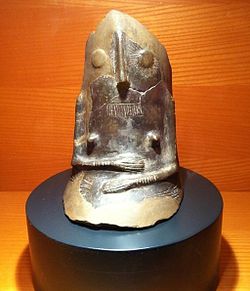

Left, Female Figure from Willendorf, Austria, 30,000 years old, limestone, 4", probably the most famous paleolithic figurine, middle, female figurine from Gava Mines, Neolithic, made of aluminum alloy, from ~5500 years ago, 6", from Gava, about 30 minutes south of Barcelona, at right, Lady of Elche, 450 bce (or about 2500 years ago), limestone, 18", found about 5 hours south of Barcelona, Hellenistic influence.
The periods Paleolithic, Mesolithic, and Neolithic all Stone Ages (lithic means stone), based on the fact that the major artifacts that remain from their existence were stone tools (though archeologists have also found small portable stone and bone sculptures of women, animals, phalluses, and geometrical forms, as well as musical instruments, especially flutes and drums from the paleolithic, and pottery, woven material, and more, from later periods). In most locations with deep human history, people went through paleo-, meso-, and neo- stone age phases during their prehistories, with the phases lasting different lengths based on how quickly agriculture and manufacture of more varied objects developed. Climate and geography played powerful roles in shaping the speed and style of the innovations that mark the shift from paleolithic to `mesolithic to neolithic.
I covered the paleolithic period briefly in my first post; the Mesolithic was a much shorter period that left little archeological evidence in Spain. The Mesolithic typically emerges when a change in climate or migration to a gentler climate made for a reduction of megafauna and a longer growing season. Those combined to nudge people o more dependence on fishing, farming, and, in a few cases, animal husbandry. Settling in one place requires more time and effort to produce food, but also offers the stability of surplus food for off seasons and no requirement to follow game from place to place.


Paleolithic Folks lived nomadically in hide, wood pole, and skin tents and at the mouths of caves, Neolithic People settled in villages-- sometimes villages that grew barnacle-like into towns many thousand. In the mesolithic, people depended on a little of both, raising crops, travelling, sometimes seasonally, to hunt, and beginning to domesticate animals and produce many more useful objects. These phases happened at different paces in different places.
It also means people could have more stuff. So, the Mesolithic is marked by more and also smaller and more refined stone tools, and modest creation of pottery and textiles. But, the villages remained small, with simple structures, and did not feature elaborate burial sites that would follow in the Neolithic Period.
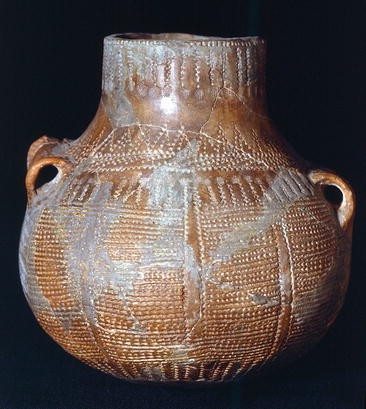 |
| Cardium Pottery, |
Even though we will likely see almost no evidence of these periods, I particularly wanted to mention the Neolithic Revolution, because we'll see several ways that innovation revolutions play a particularly significant and visible role in Barcelona, and, of course, there's a direct connection for us to consider in that we are living through a moment of revolutionary tech innovation in 2026.
 |
| Mesolithic Dolmen Tomb from Andalusia, about 5700 years ago (or 3700 bce= before the common era). A dolmen is a tomb using megalithic (huge stone) architecture.) |
In Spain, the Neolithic Revolution began 7-8000 years ago, when agriculturalists brought in cereals and legumes as already-proven crops and discovered and refined more through selective planting. With increased agriculture, labor became more difficult and specialized, food quality actually deteriorated, but higher-calorie foods meant that those not responsible for labor could invest their time in other efforts-- from war to record-keeping to craft manufacture to entertainment. (If anybody's interested, we can chat in Spain about the still-trendy paleo diet and it's relationship to social stratification.)
Agriculture improvements, social stratification, accumulation of goods, and political organization made possible by the neolithic revolution made building larger communities possible. Larger cities grew up during the Copper Age, marked by the earliest metal-working, when people used copper, silver, and gold for mostly decorative purposes, still relying on stones for tools. In Spain, metal-smithing emerged about 3200 bce, when villages became cities reliant on government organization, social stratification and trade with Africa to the South and the Baltic regions to the east. For context, this is the same time that Ötzi, the famous iceman, lived.
 |
| Model of an Early Copper Age village, about 3200 bce (5200 years ago) |
Next, the Bronze Age in Spain saw an increase of fortifications, indicating that the threat of invation lurked. In Catalonia, there's evidence that Celts came in from the north at the easternmost side of the Pyrannees and established cities. I think you'll start to detect more functional and aesthetic qualities familiar to you from history classes and popular media. The Celtic civilisation in Catalonia is known as the Urnfield Civilization after their practice of cremating the dead and burying urns with their ashes.


You might detect similarities between the objects above-- armor and an urn-- made of bronze, and some of the earliest Iron Age objects from Europe such as these from the Villanovan culture in Italy from about 900 bce.

During the iron age trade and interchange between civilizations increased rapidly, the prehistory of Spain in the last 800 years before the powerful Romans arrived on the Iberian Peninsula in 218 bce, there is evidence of many many different cultures and cultural influences-- the most well known cultures are the Tartassans and Iberians in the South of Spain, and all over the penisula archeologists find evidence from Greece, Phoenecia, Carthage, and more.
Next time, I'll focus on the Romans and, particularly, evidence of the Roman period in Barcelona.
Buenos noches y dulces sueños, compadres,
Betsy


Comments
Post a Comment