Prehistory- Part I: Geography and Oldest Human History of Spain
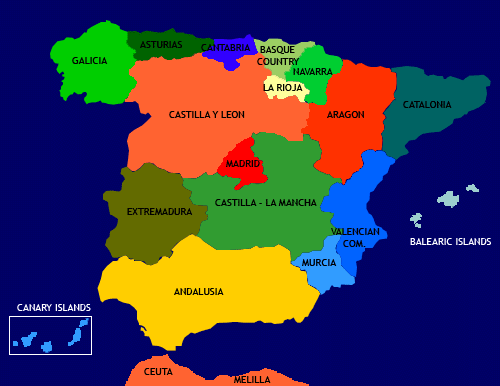 |
| Regions of Spain |
Spain is the fourth-largest and seventh most populous European country, and shares the Iberian Penisula with much smaller Portugal in the east, and tiny Andorra in the north, and Gibraltar in the south. Overall, Spain is very mountainous, with an average elevation of 2100 feet. By comparison, NC has an overall elevation of 700 feet. As a peninsula (perhaps obviously) Spain has vast Atlantic and Mediterranean coastlines; 360 miles of which are in Catalonia.
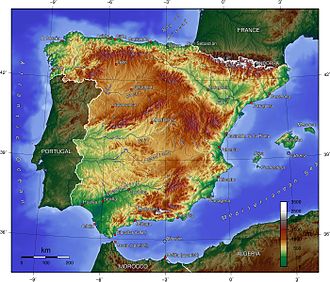 |
| Map from Wikipedia. |
That's where we will be: in Catalonia (Spanish name: Cataluña, Catalan name: Catalunya), the northeasternmost of the 17 autonomous communities of Spain. Barcelona is the capital of the community. To the North lie the Pyranees Mountains and French border, to the east, the Mediteranean Sea, to the West, the autonomous community of Aragon and to the south, that of Valencia.
Spain has a varied climate; in both Barcelona and Celrà we will be in a Mediterranean zone, characterized by mild, wet winters & hot, dry summers. Catalonia is one of the more agriculturally and ecologically rich parts of Spain. In June and July, expect temperatures in the mid- to high- 80's in the day, dropping down to low 70's at night.
That gets me to a first recommendation: Europeans do not cool their homes to the same degree Americans do, and air conditioning is not universal. We recommend that you start now spending some time outdoors moving every day, and, if you have the power to do so, turn your thermostat up a couple degrees every couple of days to get used to the differences in Spain.
 |
| Map from this random wordpress about Spain |
I'll touch here on just a couple of significant geographical features. First, the Pyranees, which range 310 miles across the very north of Spain, forming a significant obstacle that served as both a defensible barrier to invasion from the north and an impediment to open trade, slowing the influences of both war and trade compared to many other European nations. The second feature is the Straight of Gibraltar, a nine-mile wide passage between the Mediterranean Sea and the Atlantic Ocean, that allows for near constant exchange between Spain and Northern Africa-- today, ferries can take as little as 35 minutes... it's hard to know how long it took our human ancestors 3 million years ago, but the evidence shows that they made it across. The Straight has been a place of extremely rich cultural exchange for nearly all of the history of modern humans.
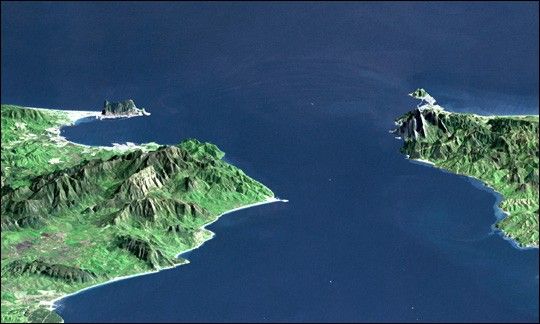 |
| 3-D Image from Nasa |
That gets us to the earliest human history in Spain. In Catalonia, we are unlikely to encounter any evidence of history prior to a few thousand years ago, unless it's on display in the Museu Nacional d'Art de Catalunya (which we will visit on the 24th of June), but I indulge myself because I really love paleolithic art.
It's hard to say exactly when humans first came from Africa to Europe, because we depend on multiple finds to confirm history and such finds are of course rare. But there are a few widely dispersed signs of our early human ancestors beginning 1.4 million years ago. That marks the beginning of the Paleolithic period (the Old Stone Age). Likely because of the Straight of Gibraltar, Spain is home to the oldest remains of our ancestors yet found in Europe. One of the most significant archeological sites is Atapuerca in the north of Spain, where digs have revealed human fossils and stone tools from about 1.2 million years ago-128,000 years ago, making the Lower Paleolithic the longest period of human history in Spain.
 |
| The dig site at Atapuerca |
Neaderthals (homo neanderthales), lived much later, from about 128,000 years ago to 35,000 years ago, a period known as middle paleolithic. The arrival of homo sapiens (that's us) starts the upper paleolithic, which began 35,000 years ago. Homo Sapiens and Neanderthals lived alongside each other and traded with each other- including their dna. If you'd like to read more about the art of the Neanderthals in Spain, I recommend this accessible article.
The first homo sapiens arrived in Spain not by boating the straight but by crossing the Pyrenees. Some of the most well-preserved, vibrant and lively examples of Upper Paleolithic cave painting are in Spain, including those at Altamira cave in northwest Spain, painted between 35,000 years ago and 15,000 years ago. I'm always amazed that people returned to caves over periods like this-- 20,000 years-- apparently just to paint and perhaps have ceremonies. The only evidence that people inhabited the deep caves where they painted was found at a few cave mouths, not deep inside where the painting sites are. Archeologists have found musical instruments in paleolithic caves... so maybe people were dancing there too.
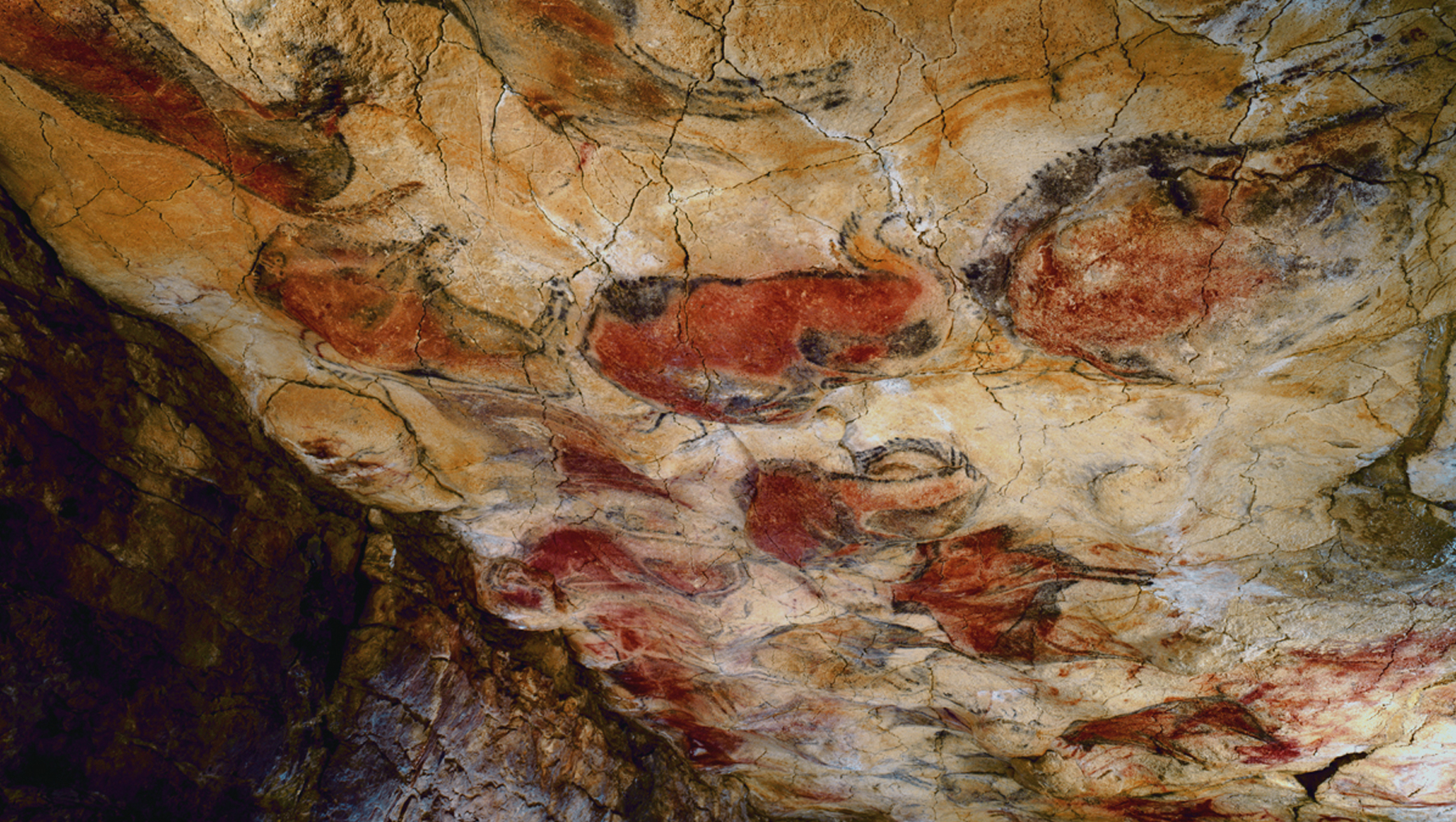 |
| Painting from Altamira Cave, in Cantabria, 35,000 YA-15,000 YA, You can see many more paintings from Altamira and other Caves at the Bradshaw Foundation, source of this image. |
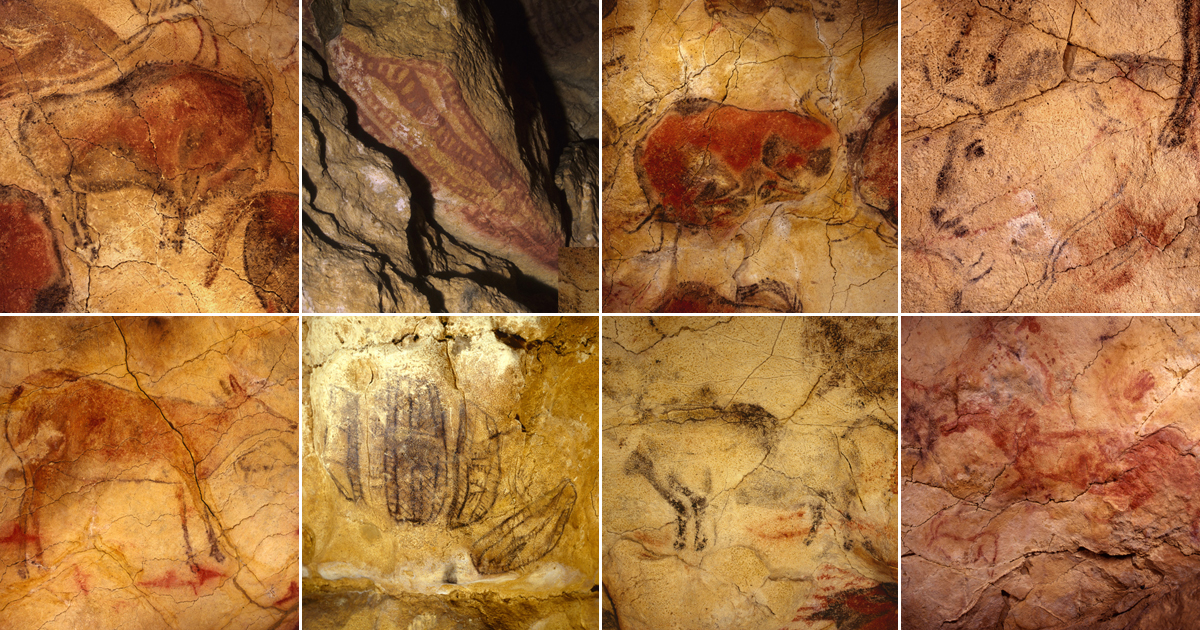 |
| Paintings from Altamira. Image source. |
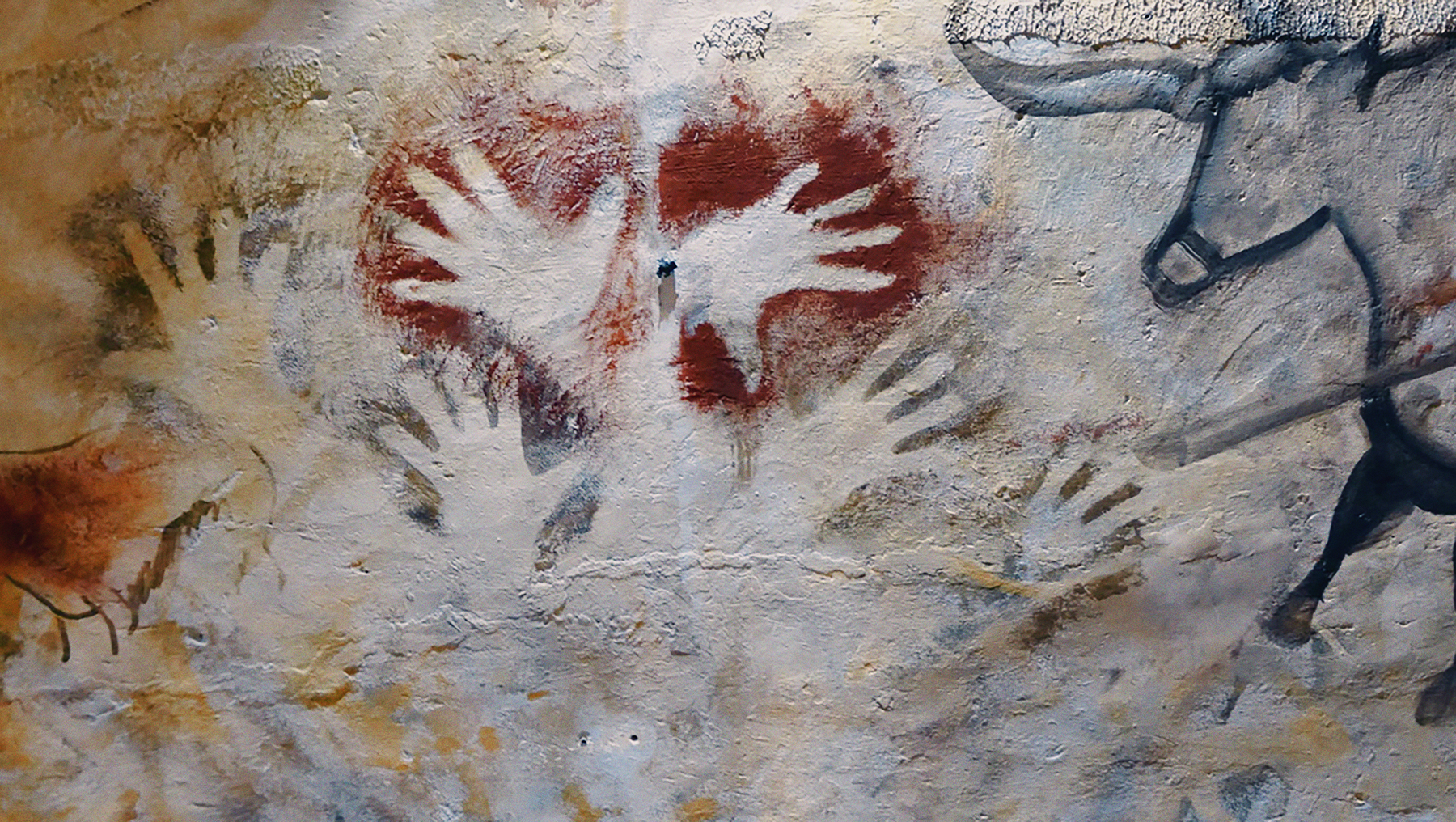 |
| Spray painted hand stencils in Altamira. In paleolithic caves in Europe, Indonesia, and North and South America, early humans used a similar technique to paint hands between 50,000 and 6,000 years ago. Image source. |
Next time, I'll summarize the periods between the Paleolithic and the arrival of the Romans, so, from about 14,000 years ago to 2500 years ago. At that point, I'll slow down and spend a little more time on the periods that we will actually see evidence of in the infrastructure and architecture of Barcelona.


Comments
Post a Comment