Locations and Neighborhoods of Barcelona
Rambling
Several in our Group mentioned that their favorite way to get to know a city is just to ramble. That's certainly true for you. Don't forget your favorite walking shoes. I'm happy that our full schedule does make room for that!
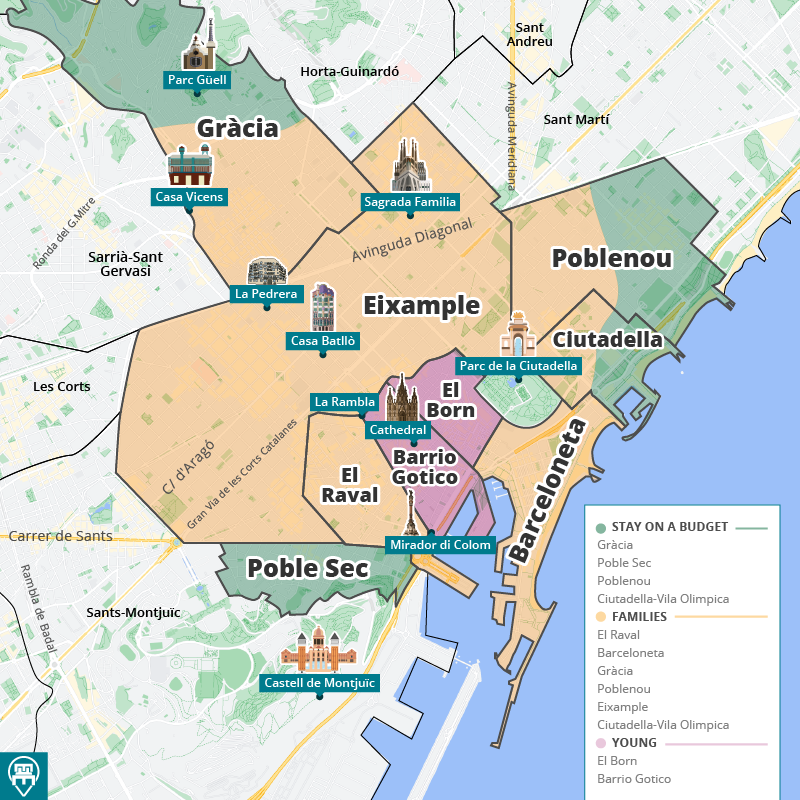
This post is not much of my original work. I've borrowed nearly everything from two tourist sites, Barcelona Life and Barcelona Tourist Guide. I've included their sublinks in many places. Barcelona Life includes much more detail. I made a google map with pins on the major places we will live, work, and play while in the city. I'll be curious to hear how helpful this is-- I didn't spend much time, but thought something like this might be helpful and was worth testing. Let me know what you think.
 |
| Map Source. |
First, Barcelona ranges over 39 square miles. In summer, we can expect pretty much everything to be crowded, most particularly the tourist areas of La Rambla and Ciutat Vella/Barrio Gótic (Old City/Gothic Quarter). I'll practice patience. On this page, I borrow descriptions for the major neighborhoods we will work, play, and wander in.
Page Content
I plan to find time to blog a bit about the Eixample District, (Catalan pronunciation= ay-SHAM-plah or uh-Sham-pluh, which means expansion in Catalan. This is the location of TOC Hostel. Eixample is the carefully-planned, well, expansion, of Barcelona that organized the city as it grew beyond the Old City. Designed in the mid-1900's by Ildefons Cerdà, Eixample was revolutionary in the way that it accomodated for modern innovations like railways, gas lines, large sewers and wider straight streets that made traffic flow more smoothly, while still preserving green spaces and parks. Eixample also features major shopping areas, bars, and restaurants, and some of the most prominent examples of Moderniste architecture, including three Gaudí landmark's we will visit , Casa Batlló, Casa Mila and Sagrada Família. This Barrio needs the grid-like plan to manage crowds. More info.
Gothic Quarter - Barri Gòtic Quarter - The "old city" in the heart of Barcelona and the "original" Barcelona where the city all started. This area is characterized by winding cobbled ancient streets, wonderfully picturesque architecture, top quality restaurants and cafes full of atmosphere.More info.
Barceloneta Barrio - Barceloneta is the closest beach to the city center where we will be. It's likely to be the busiest beach around, particularly on the first evening for the Nit de Sant Joan/San Juan, when it's one of the most popular destinations for a midnight swim.
Montjuïc - is named after the mountain on which it's built, which translates as Jewish Mountain, named for the medieval Jewish cemetary there. MontjuUic is in the south of the city, and is full of gardens, parks, and culture. The institute where we'll have workshops with Barna Arts is in this part of the city. Fantastic views and the Magic Fountain of Montjuïc (which I have on good authority is very worthwhile) and the National Catalunyan are in this area.
La Rambla Guide - La Rambla is Barcelona's most famous street. It's gonna be busy, y'all. La Rambla is a wide boulevard where pedestrians rule, it runs along the Neighborhoods of Barri Gòtic (Gothic Quarter or Old City ) on one side and the El Raval on the other. Here you'll see human statues and street performers, the 800 year old market La Bouqueria where we'll all have to get seafood or fresh veggies sometime, and some great works of art and architecture. Check the Guide at the link just above-- and scroll past the ads because there's a lot there.
Poble Sec - this place is.a big highlight as it's where Abby, Shane, and Betsy have their apartment. It's a quieter and not-so-expensive part of the city.
Barcelona Sants Neighbourhood: - Sants is a residential neighborhood on the west side on Montjuïc in the south of the city. I don't think we have anything planned there, but you might stroll during a break from the institute.
El Born Barrio - a central neighborhood close to the beach, with night life, restaurants and bars.
From here: I just quoted that passage directly from Barcelona Tourist Guide. I have not yet read more. I'll edit and add as I start to know a thing or two-- and send me your ideas!
El Raval Neighbourhood Controversial area in Barcelona, probably more suitable for seasoned travellers. Raval is an interesting and exciting area in Barcelona however it also has its darker and seedy side that you ought to be aware of. It is certainly not the safest or the cleanest area in Barcelona but it does have a special personality and character all of its own that makes this area a compelling visit."
Gràcia Barrio - Gràcia was an independent town until the late 19th century and even now the community is small and tight. However despite the trendy nature of Gràcia it is also a traditional barrio with a large elderly population which makes for an amusing and odd mix.
Les Corts District - Les Corts is an important financial business district in Barcelona and therefore has many good hotels and restaurants but not so much in the way of tourist attractions. Also, on Diagonal there is a large shopping complex called L'Illa. In L'Illa there are several good restaurants, a huge supermarket, a small exhibition centre and of course lots of clothes shops.
Plaça España And around The main draw to Plaça España is the Palau Nacional which is the Museum of Catalan art, stands regally up on the side of Montjuïc. It's stunning and there is never a better time to see it than when it is lit up at night with the Magic Fountain in front.
Bogatell / Ciutadella Areas - This area offer ready access to Bogatell Beach and the Port Olympic area (the last the venue for 1991 and the 2024 America's Cup. Easy access via the yellow line and just ten minute by metro from the center city.
Port Olympic - Modern and stylish area in Barcelona with ready access to Barcelona's beaches. This area benefited from the Olympic Games area regeneration program.


Comments
Post a Comment